The European Court of Justice’s Betaal ruling redraws the PSD2 perimeter:
When receiving and forwarding funds does - and does not - amount to providing a payment service
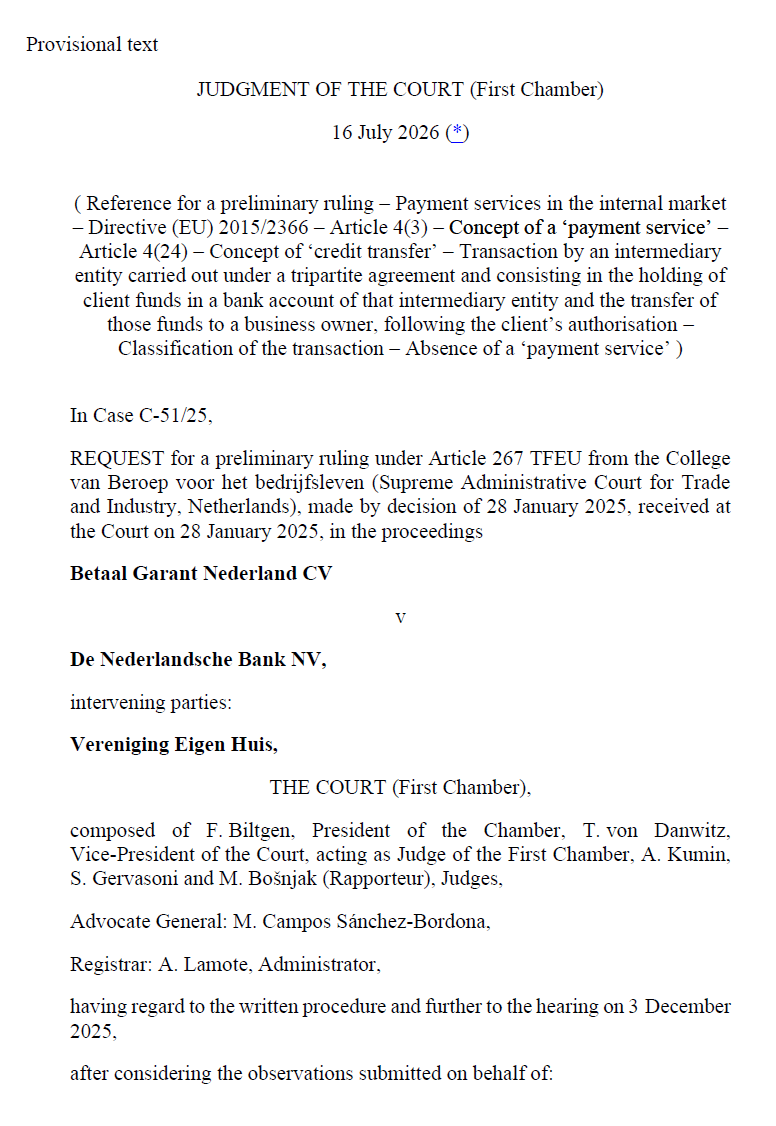
In the matter of Betaal Garant Nederland CV (“Betaal”) v De Nederlandsche Bank NV (“DNB”), C-51/25, decided on July 16, 2026, the Court of Justice of the European Union (“CJEU”) (the “Judgment”) held that a particular deposit arrangement does not constitute a payment service under PSD2, specifically the execution of a credit transfer under Article 4(3) and Annex I, point 3(c). The Judgment largely aligns with the opinion of the CJEU’s Advocate General, Manuel Campos Sánchez-Bordona, dated February 26, 2026 (the “Opinion”), which was submitted to the CJEU in the proceedings.
In its written observations to the CJEU, the Norwegian Government argued that Betaal’s activities constitute money remittance. The Advocate General expressly rejected that classification in his Opinion. The Court did not separately address Norway’s money-remittance argument. However, in paragraph 27 of the Judgment, it noted that the referring court relied on Commission guidance identifying money remittance as a possible alternative classification supporting DNB’s position. The Commission rejected that argument at the hearing, as recorded in paragraph 42 of the Opinion, and the Court did not pursue it further.
Instead, in paragraph 52 of the Judgment, the Court concluded more broadly that providers of security-deposit services that make ancillary use of payment services supplied by third parties fall outside PSD2’s scope. That reasoning makes it difficult to simply reclassify the same arrangement as money remittance without addressing the underlying distinction between providing a payment service and using payment services merely as an instrument to perform another substantive service.
For fintechs, digital platforms, and businesses handling client funds, the Judgment provides grounds to revisit licensing assessments that focus primarily on the receipt and onward transfer of funds. It also provides grounds for the Norwegian Financial Supervisory Authority (“FSA”) to revisit and update its guidance on payment services.
The factual background
Betaal is a company that provides advice, guarantees, and security deposit services to individuals for construction projects. The matter before the Court concerned an arrangement in which a construction client, a building contractor, and Betaal enter into a security deposit agreement. The client transfers funds to a bank account held by the Betaal Garant Foundation, an entity linked to Betaal. The deposit secures payment of the final contractual instalment and will be released upon confirmation that the work has been satisfactorily completed. The arrangement serves as an alternative to depositing security with a notary under Dutch law.
DNB asserted that Betaal's receipt of the funds and its subsequent transfer to the contractor constituted an unlicensed payment service. DNB treated the two payment legs as a single payment transaction carried out by Betaal as an intermediary. The legal basis for that assertion was Article 4(3) of PSD2, read in conjunction with Annex I, point 3(c), which concerns the execution of credit transfers (paragraphs 25–30 of the Judgment). The Court rejected that classification, focusing on both the allocation of payment functions and the primary service Betaal provided.
The Court’s reasoning
The Court interpreted the relevant provisions of PSD2 by considering their wording, the regulatory context in which they appear, and the objectives they pursue (paragraph 31 of the Judgment).
Literal interpretation
The textual starting point for the analysis is Article 4(3) of PSD2, which defines payment services by reference to the activities listed in Annex I. Regarding credit-transfer execution under point 3(c) of Annex I, the Court states that, for a credit transfer to be executed, the payer must issue a payment order to the payer’s payment service provider, and that provider must also hold the payer’s payment account (paragraph 36 of the Judgment).
In the Court’s words: “the existence of a payer’s payment account and the holding of that account by the payment service provider are characteristic elements necessary to establish that a payment transaction consists of a procedure for the ‘execution of credit transfers', within the meaning of point 3(c) of Annex I” (paragraph 37) (our underscore).
The Court treated the incoming and outgoing fund transfers as two separate payments (“two sub-transactions”):
1. The client instructs its bank to pay the Betaal foundation.
After the transfer is completed to the foundation’s satisfaction and with the client’s consent,
2. the foundation instructs its bank to pay the contractor.
Neither Betaal nor the Betaal foundation hold payment accounts for clients or contractors. Accordingly, the Court reasoned, the banks execute the transfers under the tripartite agreements: clients’ banks transfer funds to the foundation’s account, and the foundation’s bank subsequently transfers those funds to the contractors. The tripartite agreements do not make Betaal or the foundation the provider of those credit-transfer services (paragraphs 30 and 38–40 of the Judgment).
Thus, according to the Court, a literal reading of Article 4(3) of PSD2, read together with point 3(c) of Annex I, implies that the banks, not Betaal, are the relevant “payment service providers” within the meaning of Article 4(11) of PSD2 (paragraphs 30 and 38–40 of the Judgment).
Systematic interpretation
The Court next examined the regulatory context. It noted that Article 1(1) of PSD2 identifies the categories of entities entitled to provide payment services. Read together with Article 4(24) and Annex I, point 3, this indicates that PSD2 is directed at payment services and credit transfers supplied by entities falling within those categories.
The Court’s reasoning suggests that Article 1(1) does more than identify which entities may lawfully provide payment services. It also helps define the directive’s regulatory perimeter. PSD2 is aimed at businesses that provide payment services as part of their regular occupation or business activity, rather than businesses that merely use such services in support of another activity. The Court found support for this interpretation in recital 24, which frames the PSD2 regime around specified categories of payment service providers carrying on payment services as a regular business activity.
The Court explained that this limitation reflects the stringent requirements imposed on payment service providers, including authorisation, prudential supervision, and civil liability. The application of such a strict regime is justified only by “direct participation” of the payment service provider (paragraph 45 of the Judgment), but is not justified “if transfers of funds are made only in order to carry out another service offered as the primary service” (paragraph 46 of the Judgment).
Betaal does not fall within any of the categories of “payment service provider” and does not itself transfer funds (paragraph 47). Thus, the regulatory context implies that Betaal does not provide a payment service under PSD2.
Teleological interpretation
The Court also noted that PSD2 does not pursue consumer protection as its sole objective. Recital 6 of the directive calls for legal clarity and uniform application across the EU. A broad, protection-driven interpretation could undermine those objectives by extending the scope of the relevant concepts beyond their wording. In paragraph 50 of the Judgment, the Court therefore rejects consumer protection as a standalone basis for expanding the directive’s scope.
The comparison with notarial services reinforces the Court’s conclusion. Under Dutch law, Betaal’s service is a recognized alternative to depositing security with a notary. The Court found nothing in PSD2’s provisions or overall structure to suggest that notarial services were intended to be subject to payment-services authorisation requirements (paragraph 51 of the Judgment). In doing so, the Court implicitly endorses the Advocate General’s argument in his Opinion, which states that “they are not professional and regular providers of such services as their main activity, but rather they do so on an ancillary or peripheral basis, that is to say, as a complement to their own functions” (cf. paragraph 77 of the Opinion).
Thus, a purposive (“teleological”) interpretation of the directive also supports the conclusion that Betaal’s security-deposit service is not subject to PSD2 authorization requirements.
Conclusion
These considerations led the Court, in paragraph 52 of the Judgment, to conclude that providers of security-deposit services fall outside the directive’s scope when they use other providers’ payment services as an ancillary service.
The Judgment clarifies that having a bank account is not equivalent to “holding” a payment account for a customer under PSD2. The tripartite relationship did not change who executes the bank transfers, although its security provisions remain relevant to identifying the separate service Betaal provides. The mere occurrence of payment transactions did not establish that Betaal provides a payment service (paragraphs 40–41 of the Judgment).
The Commission had already adopted a similar functional distinction in Q&A 2022_6489 regarding a multilateral netting centre. Although the association in question received funds from net-paying members into an account in its own name and paid net-receiving members, the Commission considered that it appeared to act as a payment service user rather than a provider. Betaal gives considerably greater legal weight to the underlying distinction between using and supplying payment services. However, as set out in Q&As 2020_5216 and 2020_5099, receiving and forwarding funds may constitute money remittance or acquiring, depending on the contractual structure.
Ancillary use of payment services vs ancillary provision
The Court’s conclusion that Betaal merely uses payment services, and that this does not make it a payment service provider, seems to leave a broader question open:
Can the Judgment also support the view that providing payment services as an ancillary part of another substantive service does not necessarily require a license?
The Court’s reasoning supports that interpretation. In paragraph 46 of the Judgment, the Court states that PSD2’s authorisation, prudential, and liability requirements are not justified when “transfers of funds are made only in order to carry out another service offered as the primary service.” Read alongside paragraph 43 of the Judgment, which invokes recital 24, this suggests that the relationship between the payment activity and the primary service it supports matters for PSD2’s scope. Thus, the analysis is not confined to identifying which payment service provider executes the transfers. It must also consider whether those transfers are complementary to the performance of another primary service.
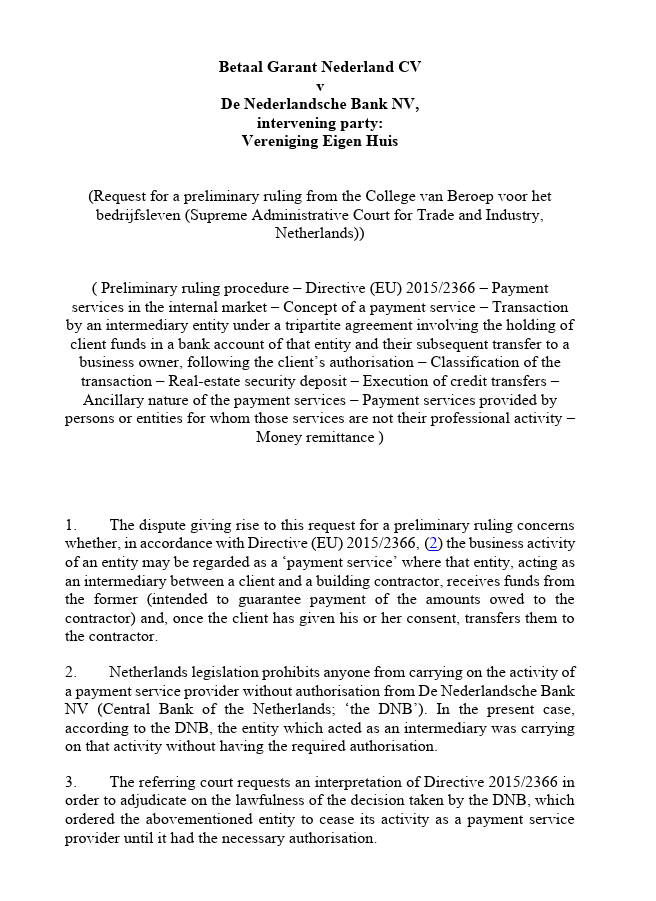
The Advocate General articulated this argument more explicitly in paragraph 79 of his Opinion: “providers of mere security deposit services who, on an ancillary basis, provide payment services are excluded from the scope of Directive 2015/2366.”
The opinion of the Advocate General of the European Court of Justice
According to Advocate General, “The requirement that the provision of payment services should be a professional activity and should be the provider’s main activity is explained by the legislative context of Directive 2015/2366” (our underscore), cf. paragraph 59 of the Opinion.
The Advocate General’s arguments address the ancillary provision of payment services, not merely their ancillary use. This strengthens the argument that payment services complementary to the provision of another primary service fall outside PSD2’s scope. The Court provides support for this view in paragraph 46 of the Judgment.
The Advocate General’s money-remittance analysis further supports the interpretation that payment services complementary to the provision of another primary service fall outside PSD2’s scope. In paragraphs 91–92 of his Opinion, he argues that remittance must be conducted professionally as a main activity to be subject to a licensing requirement, rather than merely as a means of providing the security-deposit service. Even if Betaal’s arrangement involved remittances, he considers them ancillary to that service. This provides an additional ground for rejecting Norway’s position, alongside his separate reasoning on the conditional nature of the onward payment (see below).
However, paragraph 94(b) of the Advocate General’s Opinion identifies an important limitation. Retailers’ bill-payment services are offered as standalone services within a broader catalogue of services. They are not merely complementary or instrumental to another service. The distinction is thus not between a company’s largest and smaller business lines, but between payment activities that enable another primary service and payment services offered as standalone services.
Thus, the Judgment and the Opinion give rise to two propositions:
Narrow proposition, clearly established by the Court: the ancillary use of payment services supplied by others does not, by itself, make the user a payment service provider.
Broader proposition, strongly supported by the Advocate General and arguably by paragraph 46 of the Judgment: payment functions genuinely instrumental to another primary service fall outside PSD2 even if they could otherwise be described as payment activities.
What is involved in “executing” a payment transaction and “holding” an account?
“Executing” a payment transaction under PSD2
The Advocate General seeks to clarify the meaning of “execution of credit transfers” in his Opinion. In paragraph 47, he writes that it “implies technical involvement with the accounts by the payment service provider.” (our underscore)
He continues, “neither Betaal, nor its Foundation, is involved technically in that way, since they do not hold accounts in the name of the clients, nor do they manage accounts belonging to the clients. The technical operations for executing credit transfers and payment transactions are carried out by their respective banks,” cf. paragraph 48 of the Opinion (our underscore).
In a footnote to paragraph 47, the Advocate General writes:
“In that regard, I agree with the statements made by the court a quo in paragraph 13.5 of the order for reference: ‘… it could be inferred from the context of the provisions in the chapter ‘Execution of payment transactions’ (Articles 78 to 93) of Directive 2015/2366 and the definitions of payment transaction, payer and payee, that the execution of payment transactions is principally to be understood from a technical perspective and that ‘execution’ refers to the execution of a payment transaction on a payment account. … Those provisions appear to assume the direct and technical involvement of the payment service provider in the transfer of funds from one payment account to another.’ Emphasis added.” (our underscore)
The Court itself does not formulate a general “technical involvement test,” and the Advocate General's Opinion does not carry the same legal weight as a Court Judgment. However, the Advocate General's explanation provides a persuasive account of what the Court's account-based requirement means operationally. In our view, based on the Opinion, “executing” a credit transfer should be understood from a technical perspective: direct technical involvement in transferring funds from one payment account to another is required to provide this payment service.
“Holding” a payment account under PSD2
Furthermore, the Advocate General views “holding” an account in the client’s name as a prerequisite for the direct and technical involvement required to “execute” a credit transfer under PSD2.
His reference to “technical involvement” helps clarify what “holding” means in this context. He argues that executing an account-based payment transaction requires direct involvement with the relevant payment account: the payment service provider operates the account from which the transaction is executed. The Court expresses the same idea more formally in paragraphs 36–40 of the Judgment: for a credit transfer under Article 4(24) to take place, the relevant payment service provider must hold the payer’s payment account, and in Betaal, the banks did so and executed the transfers.
Accordingly, under PSD2, “holding” a payment account for a customer is best understood as providing and maintaining the customer’s account within the provider’s payment infrastructure, including the technical capability and responsibility to record transactions on that account and to execute payment orders against it. It is not sufficient for an intermediary to merely receive or control customer-related funds in an account held in the intermediary’s own name.
Thus, in practical terms, “holding” the payer’s payment account normally means that the provider:
maintains the payment account relationship with the payer;
records the payer’s balance and the debits and credits to that payment account in its own account/ledger infrastructure;
receives payment orders from the payer in its capacity as the payer’s payment service provider; and
has the operational responsibility and ability to debit that payment account and execute the resulting payment transaction.
Thus, to “hold” the payer’s payment account for purposes of Article 4(24) is, in substance, to perform the account-servicing function described in Article 4(17) (account-servicing payment service provider/ASPSP): providing and maintaining that payment account for the payer.
Implications for Norwegian payment law
The judgment informs the interpretation of Norwegian law
PSD2 is incorporated into the EEA Agreement, and Norway has transposed its provisions into national law.
In its PSD2 guidance, the Norwegian FSA identifies control over other persons’ funds in payment transactions as a central factor in determining whether an entity provides payment services. However, the Betaal judgment reinforces an important qualification that appears absent from the guidance: control over funds alone is insufficient; the intermediary’s own activity must meet the statutory definition of a payment service.
Thus, under Norwegian law, an assessment should, following the reasoning in the Betaal judgment, identify who “holds” the relevant accounts, who performs the payment function from a technical perspective, and which primary service the intermediary provides. The Norwegian FSA’s PSD2 guidance should be revisited to reflect the interpretations in the Betaal Judgment.
Norway’s money-remittance argument
As noted in the Advocate General’s Opinion, the Norwegian Government argues that Betaal provided a money-remittance service within the meaning of Article 4(22) and Annex I, point 6, of PSD2. The absence of customer payment accounts did not preclude that classification, because money remittance expressly covers services provided without such accounts. Norway also drew a parallel with the bill-payment services offered by supermarkets and other retailers described in recital 9 of PSD2. This argument proposes an alternative basis for requiring authorisation, independent of DNB’s classification of Betaal’s service as the execution of credit transfers (points 83–87 and 93 of the Opinion). The Advocate General argues that several arguments support rejecting that view.
First, the Advocate General distinguishes Betaal’s conditional security arrangement from a simple remittance, which he characterises as immediate and unconditional. Under Betaal’s arrangement, the construction work had to be completed to the client’s satisfaction before the Betaal Foundation transferred the funds from its account to the contractor’s account (paragraph 89 of the Opinion).
Second, related to the first argument, he finds that Betaal’s arrangement lacks the automatic, unconditional character of a simple remittance (paragraph 90 of the Opinion). The distinction is not merely a matter of settlement timing: the funds are retained to fulfil a substantive security function, and their release depends on performance under the construction contract.
Third, in paragraphs 91–92 of the Opinion, the Advocate General reasons that money remittances require authorisation only if conducted professionally and regularly as a main activity, rather than merely as an ancillary element of the security service. Even if the transfers under Betaal’s arrangement could be characterised as remittances under PSD2, he considers them instrumental to Betaal’s business of arranging security for payments to contractors. His reasoning therefore goes beyond the absence of customer payment accounts: it focuses on whether Betaal offers remittance services in its own right or merely as a means of fulfilling its security obligation.
In paragraphs 93–94 of the Opinion, the Advocate General rejects Norway’s comparison to retailers that accept payments for utility and other household bills. He draws two distinctions: those retailers transfer the full bill-payment amounts and offer bill payment as a service in its own right, rather than merely as an ancillary service. The latter distinction is particularly important: a business may provide a payment service alongside unrelated activities, whereas Betaal’s transfers were instrumental in fulfilling its security obligation.
This means that money remittance cannot simply serve as a residual category whenever an intermediary does not execute credit transfers. The Opinion challenges the assumption that receiving, holding, and forwarding funds necessarily constitutes providing a payment service in its own right. The analysis must still establish what the intermediary undertakes to do for the customer.
The Advocate General acknowledges that Article 4(22) (money remittance) fell outside the scope of the question referred to the Court and examines it additionally in case the Court chooses to address Norway’s argument (paragraphs 84–85 of the Judgment). The Court did not separately analyse money remittance or adopt the Advocate General’s specific immediacy, conditionality, and fee-deduction arguments as a test under Article 4(22). Its express ruling concerns Article 4(3) read in conjunction with Annex I, point 3(c).
Nevertheless, the Opinion remains relevant for assessing money remittance under Norwegian law. The Court expressly relied on the Advocate General’s broader reasoning about PSD2’s regulatory burdens and the ancillary character of the payment activity in paragraphs 45–46, and paragraph 52 of the Judgment reflects the same distinction between providing payment services and merely using them to support another service. A materially identical security arrangement should not be mechanically reclassified as money remittance without addressing that reasoning.
Interestingly, the Norwegian FSA classified the payment arrangements used by the organizer of the 2025 World Ski Championships (“WSC”) in Trondheim as money remittance, concluding that the organizer had provided payment services without the required license. Its assessment is set out in its letter dated 28 August 2025 (reference 25/7908). The Judgment and the Opinion justify revisiting the Norwegian FSA's reasoning, though they do not establish that its conclusion was incorrect. The central question is whether the organizer itself supplied a distinct money-remittance service or merely used payment services provided by banks and other licensed providers to perform its own substantive service. If the organizer did provide payment services, a further question is whether those services were offered in their own right or were genuinely ancillary to the organizer’s principal service.
Conclusion
The Court’s judgment in the Betaal matter shifts the focus from the movement of funds to the nature of the service actually provided when assessing whether a payment service is provided. The mere receipt and onward transfer of funds does not, by itself, make an intermediary a payment service provider. The decisive question is whether the intermediary offers a payment service and, if so, whether that service is provided in its own right or merely as ancillary to another primary service.
For Norway, that distinction matters. The Judgment and the Advocate General’s Opinion undermine the presumption that receipt and onward transfer, in themselves, constitute money remittance and call for a more precise assessment of the service actually provided. The WSC case offers a concrete test for drawing that boundary. In our view, the Judgment warrants clarifying the Norwegian FSA’s PSD2 guidance to better reflect the distinction between providing a payment service and merely using one.
This newsletter provides general information only and does not constitute advice on a specific business model or transaction.
The Betaal ruling
